October 16, 2026ALPP 2025-2026 Year in Review
In these pages, including a personal letter from Faculty Director Kristen Stilt and a first message from our new Executive Director, Lana Nadj, we detail a year of steadfast and determined work during a time of challenge and uncertainty for Harvard and for academic institutions across the country. This year also marked a milestone: more than a decade since the Program’s founding in 2014. We honor it by looking ahead and moving forward, convening as a team to set priorities for ALPP’s second decade. Our visiting fellows came from Germany’s University of Regensburg and the Max Planck Institute for Comparative Public Law and International Law to pursue their research, and they published widely in venues including the German Law Journal and Verfassungsblog. We also introduced hundreds of students to Animal Law through classes, the Animal Law & Policy Clinic, our workshop series, and events, including Animal Law Week, which drew some 250 students to five days of conversations at the intersection of animal welfare, human rights, and constitutional law. In this report you will hear from many of those students in their own words, describing how their thinking, their career plans, and in some cases the course of their lives have changed.
In these pages, including a personal letter from Faculty Director Kristen Stilt and a first message from our new Executive Director, Lana Nadj, we detail a year of steadfast and determined work during a time of challenge and uncertainty for Harvard and for academic institutions across the country. This year also marked a milestone: more than a decade since the Program’s founding in 2014. We honor it by looking ahead and moving forward, convening as a team to set priorities for ALPP’s second decade. Our visiting fellows came from Germany’s University of Regensburg and the Max Planck Institute for Comparative Public Law and International Law to pursue their research, and they published widely in venues including the German Law Journal and Verfassungsblog. We also introduced hundreds of students to Animal Law through classes, the Animal Law & Policy Clinic, our workshop series, and events, including Animal Law Week, which drew some 250 students to five days of conversations at the intersection of animal welfare, human rights, and constitutional law. In this report you will hear from many of those students in their own words, describing how their thinking, their career plans, and in some cases the course of their lives have changed.
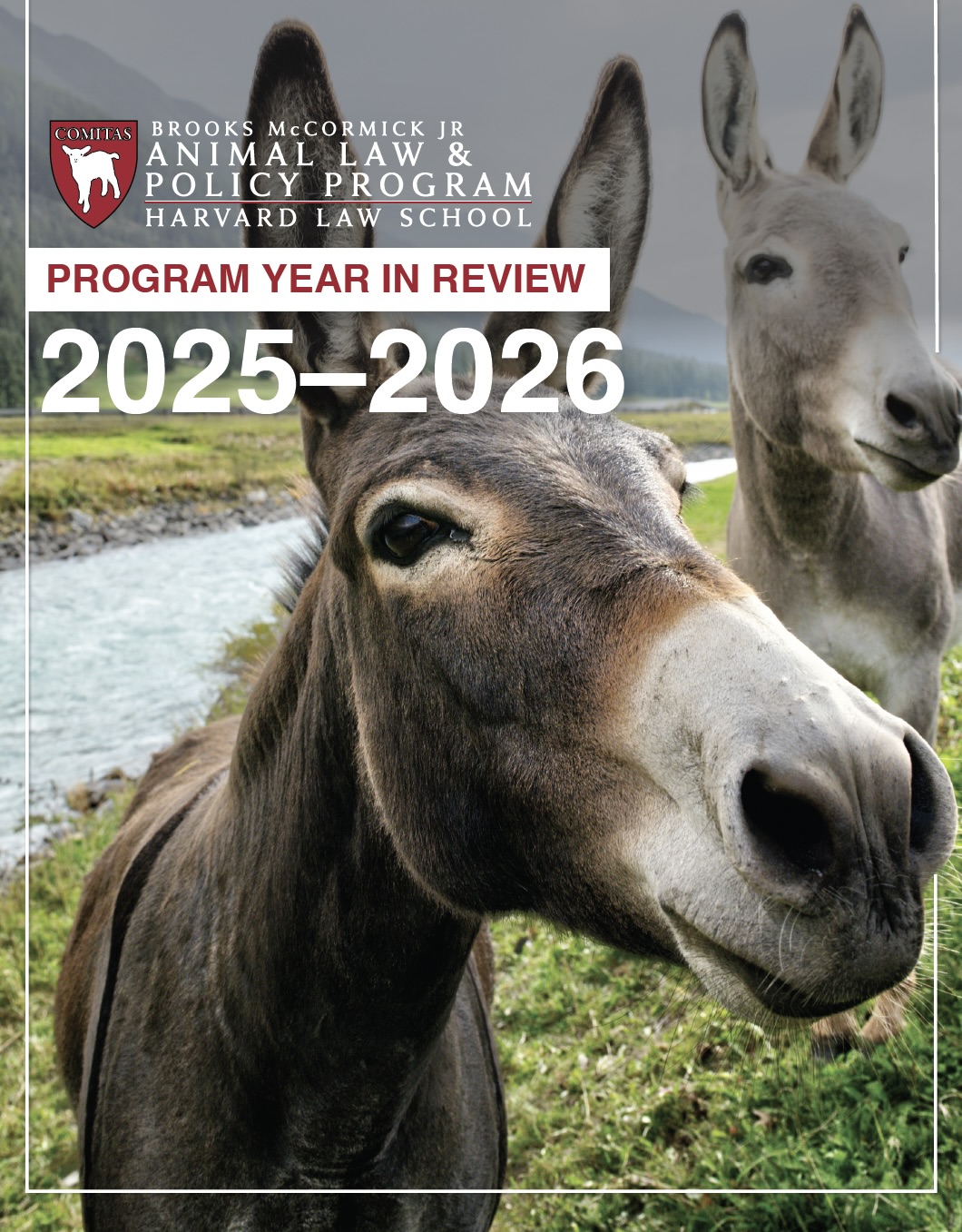
In this issue of our Year in Review, we particularly highlight the completion of The Oxford Handbook of Global Animal Law, co-edited by Kristen Stilt with Anne Peters and Saskia Stucki, which establishes Global Animal Law as a field of study. The Handbook opens with the story of Koro, a donkey in Kenya caught in the global trade in donkey hides, whose fate is shaped by many overlapping laws, norms, and jurisdictions. Its six parts cover environmental, food and agricultural, health, trade, and human rights law. It includes country and religion reports centered on understudied jurisdictions, examines implementation and enforcement, and identifies new horizons for the field. Members of the ALPP team contributed chapters throughout. Its introduction, “Global Animal Law in the Making”, is already available as a stand-alone paper. This year we also launched Phase 1 of the Assessment for Continuous Improvement, a major new project supported by Coefficient Giving (formerly Open Philanthropy). It will assess and promote improvements in the welfare of farmed land animals around the world, beginning with pilots in Australia, Brazil, Denmark, India, and Malaysia. With a seed grant from the Harvard University Salata Institute for Climate and Sustainability, we convened lawyers, scholars, tribal leaders, and advocates from the rights of nature and climate change movements for a two-day workshop that we expect will bear fruit for years to come. Our work also reached the public through The New York Times’ coverage of Ann Linder’s research on the global wildlife trade and zoonotic disease, and through Kristen Stilt’s appearance on Radiolab.
The pages that follow showcase much of what we accomplished last year. ALPP is entirely donor funded. Our successes and impact have been made possible by our extended community: those of you who come to our events, who share our publications and reports, and who support us financially. We hope you recognize your own contributions to our work as you review these pages. There is so much more that we want to do, that we must do, and that, with your support, we will do.