
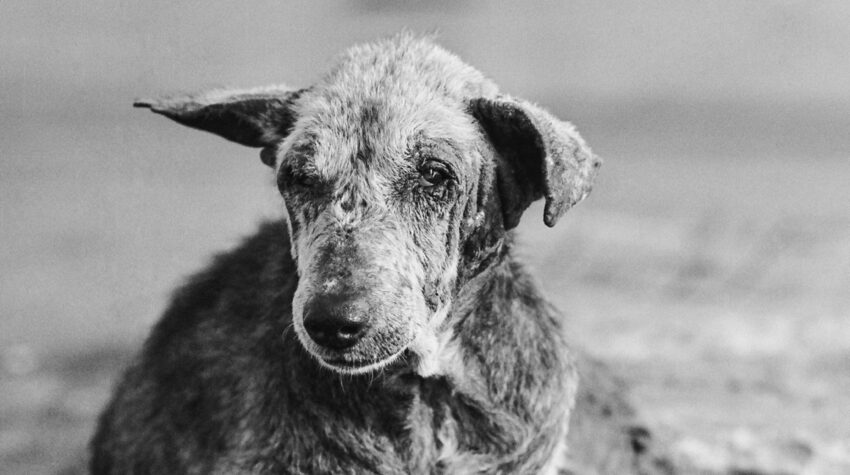
A sick and injured dog on the banks of the Ganges river. Varanasi, India, 2007. Photo credit: Jo-Anne McArthur / We Animals
October 29, 2025BlogIndia’s Supreme Court Tackles Issue of Stray Dogs
On August 11, 2025, a two-judge bench of the Supreme Court of India acting suo moto passed an order requiring municipal authorities in and around the region of Delhi and the National Capital Region (NCR) to pick up and relocate all stray dogs in the area (estimated to be around one million) to shelters and pounds that were to be “immediately” and “simultaneously” created. The Supreme Court further emphasised that “in no circumstances, should these stray dogs after their relocation be once again released back onto the streets” and that “if any individual or organisation comes in the way of forceful picking up of the stray dogs and rounding them up . . . we shall proceed to take the strictest of actions against any such resistance which may be offered.”
The order followed a news report in a local newspaper titled “Delhi hounded by strays, kids pay price,” which reported the death of a six-year-old girl from rabies in July. The report also cited with alarm the rising incidence of dog bites in the region and the inadequate enforcement of the Animal Birth Control Rules of 2023 (ABC Rules), which mandate the sterilization and vaccination of stray dogs.
While the Supreme Court order was lauded by many who felt action on the matter was long overdue, an equally large number opposed it on the basis that it was hastily delivered, impractical, and inhumane. With protests swelling, the Chief Justice of India took the unusual step of reassigning the case to a larger bench for reconsideration. This larger three-judge bench delivered its modifying order on August 22, 2025.
Describing the original order as “too harsh” and potentially “impossible to comply with,” the Supreme Court directed authorities to comply with the ABC Rules, which require dogs to be released back to the same area from which they were picked up after recovering from sterilisation, deworming, and vaccination. The Supreme Court further instructed municipal authorities to create dedicated feeding spaces for stray dogs within each ward. Significantly, it also proposed to extend the scope of the matter to the entire country, noting that application of the ABC Rules ought to be uniform nationwide. In passing these directions, the Supreme Court observed that it was important to take a “holistic approach” to the issue and that the ABC Rules already provided a solution that was “scientifically carved out” and “compassionate.”
Based on these directions, the Supreme Court ordered all state governments and union territories to file compliance reports by October 27, 2025. Yet when this date arrived, only two state governments out of twenty-eight states had complied. Displeased by their inaction, the Supreme Court verbally chastised the governments for tarnishing India’s image abroad and summoned their top bureaucrats to appear in person on November 3, 2025.
These developments lay bare both the urgency of the problem and the limits of judicial intervention. Indeed, while the present decision to strictly enforce the ABC Rules is a step in the right direction, this is not the first time such a call has been issued. What appears to remain unaddressed are the broader systemic challenges that hinder effective implementation. These include under-funding of sterilization and vaccination programmes, shortage of personnel and infrastructure, and weak accountability mechanisms. Addressing these challenges will likely require measures beyond the scope of suo moto judicial intervention, such as sustained political will, effective intergovernmental cooperation, and active community engagement.
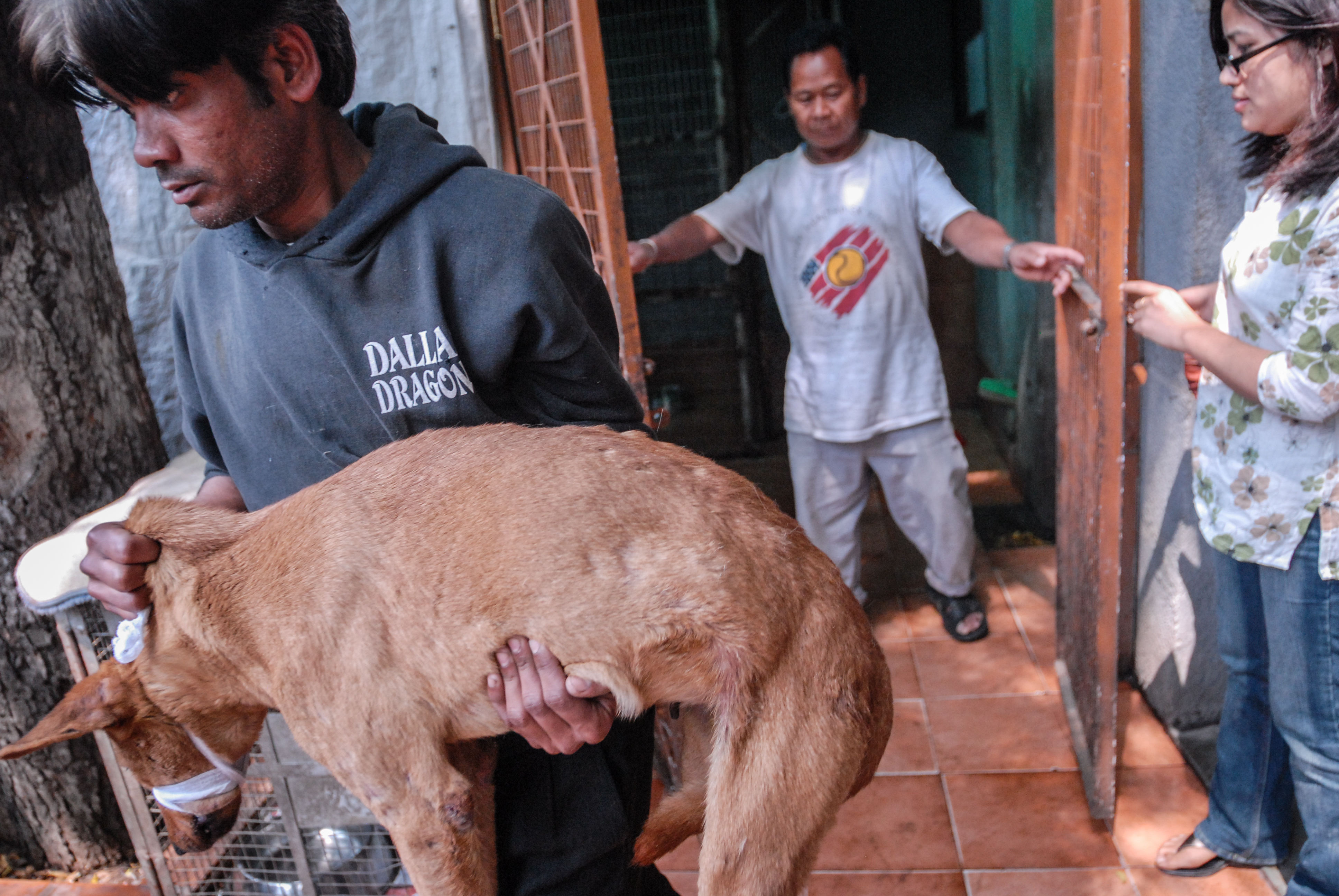
Carrying a dog for trap-neuter-release in Kolkata, India by the Animal India Trust. 2007. Photo credit: Jo-Anne McArthur / We Animals
Article authors: Siddhanth Prasad, Visiting Faculty, Sai University, Chennai, India; Yadvi Rai, Fourth Year Student (School of Arts and Sciences), Sai University, Chennai, India; Khushi Tudekar, Second Year Student (School of Arts and Sciences), Sai University, Chennai, India.