
December 12, 2025Animal Law & Policy ProgramQ&A with Lana Nadj, ALPP’s New Executive Director
We sat down with ALPP’s new Executive Director, Lana Nadj, and asked her some questions about her past, present, and future:
What lead you to the field of animal law? Was there a pivotal experience?
As a child I was intrigued by the stories that my grandmother told about her own adolescence. She had been born at the beginning of the 20th century in Belarus. During my childhood in Sydney, she would repeat her stories, sometimes adding new details. One of her stories centered on the moment of her departure from Belarus, waiting at the main train station in Vitebsk. Disease had orphaned her and she found herself the eldest of a large family. She’d had to make many heartrending decisions including the decision to sell the cow she loved, before leaving to seek work. Impoverished and grieving, in the wake of revolution, she had sent her beloved cow to a new “owner” in a neighboring village. At the precise hour of her departure she stood on the railway platform only to see her cow, who had somehow found her. She and the cow experienced a joyful and tearful reunion, and farewell. How did she find my grandmother? Was the story true, or imagined? I believed it to be true. As an adult, when a special black cat inveigled her way into my life, I was reminded of the vulnerability, agency, and deep sensitivity and intelligence that animals can possess, totally confounding the idea of humans vs. “animals.”
What is it about animal law that most interests you?
Animal law is a new portal of a hitherto neglected field that reframes the world and opens up exciting possibilities for the future of law. What does a circumstance, a rule, an idea about authority or governance look like from the perspective of someone who is so like, and yet so unlike, you – and who was (very often) not at all taken into account in their own right in the formulation of that circumstance or rule? Generations from now, what is it that humans will look back on with shame and contempt when they consider industrial animal “agriculture” and how blindly ignorant, neglectful, or deliberately cruel, we their ancestors were? At the same time, the law is a powerful tool. The rule of law, conscience and the idea of mercy are important correctives to abuses of power. Alongside cruelty, these, too, have expression in the law, and offer hard-won and significant opportunities.
What do you envision as being the key pillars of your role as Executive Director at ALPP?
An exciting opportunity to strengthen our legal community and to steadily extend outward. My first priority is to support our talented team and the cohorts of curious and brilliant students who, each semester (in growing numbers), are gravitating to this field.
What most excites you about taking on the new role?
Working in an ideas incubator (Harvard), amongst talented people (ALPP) feeds inspiration. There are so many opportunities to collaborate with programs across the United States and within the University. The fresh lens that animal law offers and the neglect of considerations of animals across so many areas in life and scholarship (from medicine to food policy and even environmentalism) invites these opportunities. We anticipate a strong and energizing Animal Law Week in the last week of March and first week of April next year. We hope alumni can reconnect with each other and Professor Stilt and the team and hear fantastic guest speakers.
What opportunities and challenges for ALPP do you see on the near to mid-term horizon? How about longer term?
The Program’s strong track record of cutting-edge scholarship sets us up for success. Having said this, the U.S. is experiencing tumultuous times. And fiscal restraint is the current mood within the academy. Without research to inform law-makers and advocates, and courts, through papers, reports and well-reasoned amicus briefs, decision-making is that much the poorer. More broadly, whether times are tumultuous or not, there are powerful interests to be reckoned with in this field, which is a challenge for the movement. Some animal exploitation is heavily resourced and challenging this takes strategic thinking and collaboration. There are also significant trends that can be identified and even averted, if sufficient resources can be deployed for sensitive investigations to be undertaken and relationships to be built. Deeply questioning aquaculture as a positive dietary and climate solution is one example of current challenges that are also huge opportunities for discourse and collaboration.
What do you see as the role of academia in animal law?
When we function best, we bring diverse perspectives together through exercising our convening power; we collaborate to foster growth and development, and we work to equip decision-makers with the evidentiary basis and sound principles that can guide the best possible decisions.
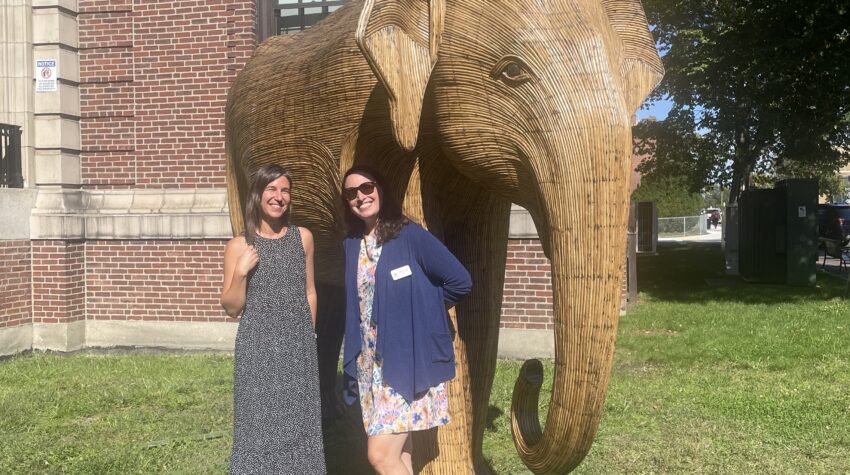
Can you tell us who the sculpture represents in the photo above?
Yes. Madhubala now lives with her sister, Malika, in Karachi Safari Park. She is an African elephant and was the last captive elephant in a zoo in Pakistan. With the assistance of FOUR PAWS and the authority of the High Court of Sindh, Madhubala had health care including dental surgery, and was reunited with her sister. The life-sized sculpture, now on the lawn of City Hall, Chelsea, Mass., is the work of The Real Elephant Collective of Tamil Nadu. Made from lantana the sculpture is one of 100 life-sized representations that, amazingly, travelled in convoy from Rhode Island through Wyoming to LA with photo stops in the landscape along the way, in tribute to these elephants and their kin. The other human in the pic is Melanie Lary, Research and Campaigns Manager, FOUR PAWS USA.